Materials Characterization
Techniques:
Raman, FT-IR, XPS, XRD, EDX, SEM, TEM. Used for structural, chemical, thermal, and morphological characterization of advanced materials for electrochemical and thermal energy systems.
Materials Characterization Techniques & Instrumentation:
Raman spectroscopy - Performed Raman analysis to evaluate graphitic structure, defect density, and doping effects in graphene-based materials; interpreted D, G, and 2D band features to assess structural quality and material evolution during synthesis and processing.
FTIR spectroscopy - Used FTIR to identify functional groups and chemical bonding in nanomaterials and composite systems; applied to monitor surface functionalization and chemical interactions between nanomaterials and host matrices.
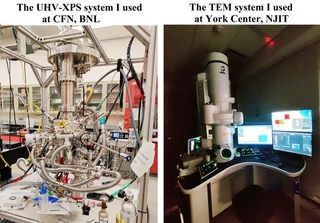
X-ray photoelectron spectroscopy (XPS) - Conducted XPS analysis to determine surface elemental composition, bonding states, and nitrogen doping configurations in carbon-based materials; used for surface chemistry evaluation and catalyst active-site analysis.
X-ray diffraction (XRD) - Applied XRD to characterize crystal structure, phase composition, and structural evolution of nanomaterials including MOFs and graphitic materials; used to assess crystallinity and phase stability after synthesis or thermal treatment.
Scanning electron microscopy (SEM) - Utilized SEM to examine surface morphology, particle size, and microstructural features of nanomaterials and composite systems; supported structural analysis and morphology–performance correlations.
Transmission electron microscopy (TEM) - Performed TEM imaging to investigate nanoscale structure, lattice features, and dispersion of nanomaterials within composite systems; used to evaluate particle morphology and structural integrity.
Energy-dispersive X-ray spectroscopy (EDS) - Applied EDS elemental mapping and compositional analysis to confirm elemental distribution and composition in synthesized nanomaterials and composites.
Materials Characterized:
- Graphene, Graphene Oxide (GO), Nitrogen-doped Graphene (N-G)
- Metal-organic Frameworks (MOF)
- MXenes
- Phase Change Materials (PCMs)
- Composite materials
