Chemical Changes from N-doped Graphene and Metal-organic Frameworks to N-G/MOF Composites for Improved Electrocatalytic Activity
Jan 15, 2025·,,·
0 min read
Niladri Talukder
Lead Author
,Yudong Wang
Xiao Tong
Eon Soo Lee
Abstract
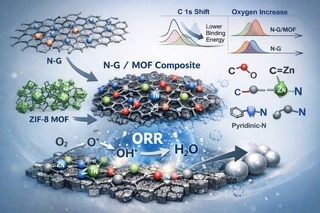
Integrating N-doped graphene (N-G) with Metal-Organic Frameworks (MOFs) enhances catalytic activity for oxygen reduction reaction (ORR), often exceeding both the performances of their precursors and, in some cases, even Platinum group metal (PGM)-based catalysts. However, the factors driving this improved catalytic activity in N-G/MOF composites remain unexplored, particularly from the perspective of the chemical changes. To investigate the chemical changes in N-G and MOF upon their integration and the implications of these changes on ORR catalytic activity, an N-G/MOF was synthesized from N-G with a MOF (ZIF-8) following a mechanochemical wet ball milling process. The N-G, ZIF-8, and N-G/MOF samples were examined for changes in elemental composition, chemical state of carbon, different nitrogen and carbon bonds, and other chemical interactions. In the N-G/MOF catalyst, compared to its N-G and ZIF-8 precursors, the relative oxygen content increased, indicating the formation of additional oxygen-containing groups. The C 1s peak shifted to a lower binding energy in N-G/MOF, suggesting changes in the overall chemical or oxidation state of the carbon atoms. Besides, the increase in pyridinic-N functional groups in N-G/MOF points to the formation of additional active sites. Furthermore, the formation of C–Zn bonds in N-G/MOF suggests the probable emergence of single-atom Zn sites, while the increase in C=O bonds points to the formation of carboxyl or carbonyl groups. These chemical changes could be linked to the enhanced electrocatalytic activity of the N-G/MOF composite for ORR. This study may also be beneficial for other research focused on developing composite catalysts involving various N-G and MOFs-based materials.
Type
Publication
Carbon (ELSEVIER)