Advanced Phase Change Materials for Wide-Range Thermal Energy Storage
Project Description
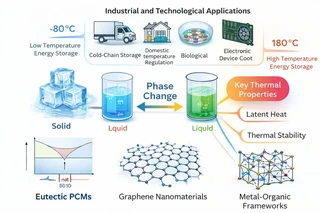
This project focuses on the development of advanced Phase Change Materials (PCMs) operating across a broad temperature range of −80 °C to 180 °C for diverse industrial and technological applications. Targeted application areas include cold-chain storage, domestic temperature regulation, transportation of temperature-sensitive bio-products, and thermal management of sensitive electrical and electronic devices.
A central objective of this research is the enhancement of thermal performance of PCMs through innovative material formulation and synthesis strategies. Molecular-level design approaches are investigated to optimize key thermal properties such as latent heat capacity, thermal conductivity, and thermal stability.
To address low-temperature energy storage requirements, eutectic PCM systems are being designed to achieve tailored phase transition temperatures and efficient thermal energy storage and release. Additionally, the project explores the integration of graphene-based nanomaterials into PCM matrices to leverage their exceptional thermal conductivity and improve heat transfer performance.
Furthermore, Metal-Organic Frameworks (MOFs) and bio-derived materials are being studied as potential additives and structural supports to further enhance the stability, durability, and thermal efficiency of PCM systems.
Through interdisciplinary materials research, advanced characterization, and collaborative development, this work aims to create next-generation PCMs with improved performance, adaptability, and energy efficiency for a wide spectrum of thermal management applications.
