
Talk at TMS 2025 - Graphene/MOF/MXene Synergy for ORR Catalysis.

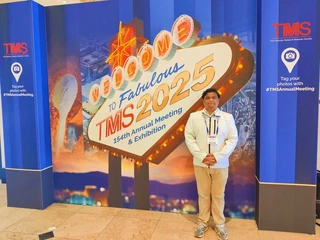
In March 2025, I had the opportunity to attend the TMS 2025 Annual Meeting & Exhibition in Las Vegas, Nevada. The conference brought together researchers, engineers, and industry professionals from around the world to discuss advances in materials science, metallurgy, and energy technologies.
One of the highlights of the event for me was delivering an invited talk titled:
“Advanced ORR Electrocatalyst from Physicochemical Integration of N-doped Graphene, MOF, and MXene by Wet Ball Milling.”
It was an exciting opportunity to share our research with an international audience and to engage with experts working on electrochemical energy systems.
The Importance of ORR Catalysts
Electrochemical energy technologies—such as fuel cells and advanced batteries—are increasingly important for building a sustainable energy future. These systems offer higher efficiency and lower environmental impact compared to traditional energy conversion technologies.
However, a key challenge remains the oxygen reduction reaction (ORR) that occurs at the cathode. This reaction often limits the efficiency of electrochemical devices.
Currently, the most widely used catalysts for ORR are platinum-group metal (PGM) catalysts. While highly effective, they are also expensive and susceptible to degradation during long-term operation. This motivates researchers worldwide to develop non-precious metal catalysts that are both efficient and durable.
Our Approach: Integrating N-Graphene, MOF, and MXene
In this research, we explored the development of a new class of carbon-based composite electrocatalysts by integrating three advanced materials:
Nitrogen-doped Graphene (N-G)
Metal–Organic Framework (MOF), specifically ZIF-8
Ti₃C₂ MXene
Each of these materials brings unique advantages:
N-doped graphene provides excellent electrical conductivity and catalytically active nitrogen sites.
MOFs offer highly porous structures that increase accessible surface area and catalytic site distribution.
MXenes contribute high electrical conductivity and chemically active transition-metal sites.
By combining these materials, we aimed to create a synergistic catalytic system capable of outperforming traditional catalysts.
Synthesis Using Wet Ball Milling
A key aspect of this work was the use of a Nanoscale High Energy Wet (NHEW) ball milling process, which enables the physicochemical integration of different nanomaterials.
The synthesis pathway involved several stages:
Nitrogen-doped graphene (N-G) was synthesized from graphene oxide and melamine.
The N-G material was then combined with ZIF-8 MOF to form an N-G/MOF composite catalyst.
In a later stage, Ti₃C₂ MXene was incorporated to produce an N-G/MOF/MXene composite catalyst.
This scalable synthesis approach allows strong interactions between the different components while preserving their functional properties.
Catalytic Performance
The electrochemical evaluation revealed several promising results.
The N-G catalyst alone demonstrated catalytic activity comparable to the benchmark 10 wt% Pt/C catalyst.
When the MOF structure was integrated, the resulting N-G/MOF composite showed even better performance than Pt/C in an alkaline electrolyte.
Finally, the N-G/MOF/MXene composite catalyst exhibited the highest catalytic activity and durability among the tested materials.
This enhanced performance can be attributed to several synergistic effects:
Transition-metal catalytic sites from MXene-derived components
Formation of catalytic TiO₂ active sites
The porous framework of the MOF
Nitrogen-active sites within the graphene structure
Highly conductive titanium-carbide layers of MXene
Together, these features created a highly efficient electron transport pathway and increased catalytic active sites.
Durability and Stability
Durability is a critical factor for practical catalyst applications. Our results showed that the composite catalyst exhibited excellent structural stability during operation.
Strong bonding between metal, metal-oxide, and carbon structures helped prevent metal leaching, while the graphene framework helped protect MXene surfaces from oxidation and passivation.
These characteristics indicate that the N-G/MOF/MXene composite has strong potential as a durable non-precious metal ORR catalyst.
Reflections from the Conference
Presenting this work at TMS 2025 was a rewarding experience. The conference provided an excellent platform to exchange ideas with researchers working on:
Electrocatalysis
Advanced nanomaterials
Energy storage technologies
Sustainable energy systems
The discussions and feedback from attendees offered valuable insights and new perspectives for future research directions.
Conferences like TMS are not only about presenting results—they are also about building connections, sharing ideas, and learning from the global research community.
Looking Forward
The development of efficient and durable non-precious metal catalysts remains an important challenge in electrochemical energy technologies.
Our work on N-G/MOF/MXene composite catalysts demonstrates how integrating multiple functional nanomaterials can create powerful catalytic systems.
I look forward to continuing research in this area and exploring how these materials can contribute to next-generation fuel cells, batteries, and sustainable energy technologies.
⭐ A memorable moment:
Presenting this work as an invited speaker at TMS 2025 was an important milestone in my research journey, and I am grateful for the opportunity to share our work with the international materials science community.
