
🎤 Attended the MRS Fall 2024 Exhibit

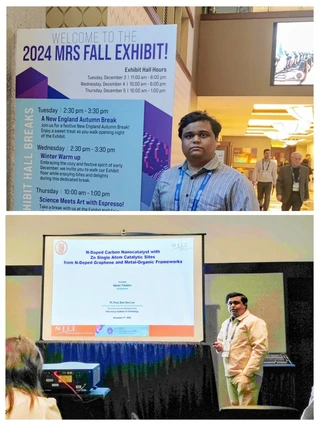
In December 2024, I had the opportunity to attend the Materials Research Society (MRS) Fall Meeting 2024, one of the largest international conferences in materials science. During the conference, I delivered an oral presentation titled:
“N-doped Carbon Nanocatalyst with Zn Single Atom Catalytic Sites from N-doped Graphene and Metal-Organic Frameworks.”
The meeting brought together researchers from academia, national laboratories, and industry to discuss advances in materials for energy, electronics, nanotechnology, and sustainability. It was an exciting environment to share research and learn from the global materials science community.
The Research Idea
Nitrogen-doped carbon materials—especially nitrogen-doped graphene (N-G)—have gained strong attention as non-precious metal catalysts for electrochemical reactions. These materials show promising catalytic activity for the oxygen reduction reaction (ORR), a critical process in technologies such as:
Fuel cells
Metal–air batteries
Supercapacitors
To further improve catalytic performance, researchers have explored combining N-doped graphene with metal–organic frameworks (MOFs), which provide highly porous structures and chemically tunable sites.
What Makes This Catalyst Different?
Most conventional Graphene-based catalysts undergo high-temperature treatments, where metal atoms are typically removed, leaving behind porous carbon structures.
In this work, we explored a different concept:
retaining and utilizing metal atoms within the catalyst structure.
By integrating N-doped graphene with ZIF-8 MOF using a Nanoscale High Energy Wet (NHEW) ball milling process, we created a nanocatalyst containing Zn single-atom catalytic sites embedded within the carbon structure.
These Zn sites form Zn–N–C active centers, which are highly beneficial for ORR catalysis.
Key Findings from the Study
Our experimental results showed several encouraging outcomes:
The N-G catalyst alone performed close to the benchmark 10 wt% Pt/C catalyst.
The optimized N-G/MOF catalyst achieved higher ORR current density than Pt/C in both alkaline and acidic environments.
The catalyst followed a 4-electron ORR pathway, indicating efficient oxygen reduction.
After 2000 electrochemical cycles, the catalyst retained over 90% of its activity, demonstrating strong durability.
Advanced characterization techniques—including SEM, TEM, XPS, FTIR, and EDS—confirmed the formation of Zn single-atom catalytic sites dispersed within the N-doped carbon framework.
Why Single-Atom Catalysts Matter
Single-atom catalysts are an exciting frontier in catalysis research because they allow maximum utilization of metal atoms while maintaining high catalytic activity.
In this work, the combination of:
Nitrogen-doped graphene
MOF-derived porous structures
Atomically dispersed Zn catalytic sites
created a synergistic catalytic system capable of robust ORR performance.
Thoughts
My presentation at MRS 2024 was an exciting moment in my research journey. Sharing our work on N-doped carbon nanocatalysts with Zn single-atom catalytic sites reinforced the importance of designing new catalyst architectures that can replace expensive precious metals.
Advances like these bring us closer to developing efficient, durable, and affordable catalysts for next-generation electrochemical energy systems.
