
⚡️ PhD Dissertation Defense - Success!

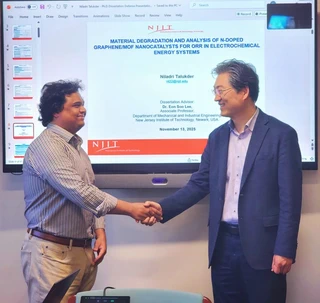 Photo credit: Rakina Islam.
During my Ph.D. research, I had the opportunity to explore a fascinating area of materials science: the development of nitrogen-doped graphene (N-G) and N-G/MOF nanocatalysts as sustainable alternatives to precious metal catalysts for electrochemical energy systems. My dissertation, titled “Material Degradation and Analysis of N-Doped Graphene/MOF Nanocatalysts for ORR in Electrochemical Energy Systems,” focuses on understanding how these advanced carbon-based materials behave during catalytic reactions.
The central question guiding this work was simple but important: how can we design efficient, durable, and affordable catalysts that can replace expensive precious metals like platinum?
To explore this, I investigated the relationships between material synthesis, structure, and catalytic performance. A major focus of the research was understanding how different nitrogen functional groups in graphene influence the catalytic activity of the oxygen reduction reaction (ORR), which plays a key role in technologies such as fuel cells and metal–air batteries.
Through a combination of material synthesis, structural characterization, and electrochemical testing, I examined how the integration of metal–organic frameworks (MOFs) with nitrogen-doped graphene modifies the electronic structure and catalytic active sites. Techniques such as linear sweep voltammetry (LSV), cyclic voltammetry (CV) helped reveal how these materials perform under different electrochemical environments, including both alkaline and acidic conditions.
Another important aspect of the research involved understanding material durability. In real electrochemical systems, catalysts can degrade over time due to reactive species such as hydrogen peroxide and related oxidative intermediates. My work investigated how these species affect catalyst stability and how the structure of materials such as ZIF-8-derived components behaves in aqueous electrochemical environments.
Overall, this research helped clarify several key aspects of structure–performance relationships in carbon-based nanocatalysts, offering insights that can guide the design of more efficient and durable catalyst materials.
Looking ahead, I am excited to continue working on next-generation electrochemical materials for sustainable energy systems. My future interests include scalable catalyst synthesis, durability engineering, and structure-driven performance optimization for technologies such as fuel cells, batteries, and other clean energy systems.
Ultimately, my goal is to contribute to the development of high-performance and cost-effective alternatives to precious metal catalysts, helping accelerate the transition toward more sustainable and widely deployable energy technologies.
Happy to research and work toward a sustainable future! 🌱⚡
Table of Contents
