
🎉 NSF I-Corps Journey - Go out and know the Market

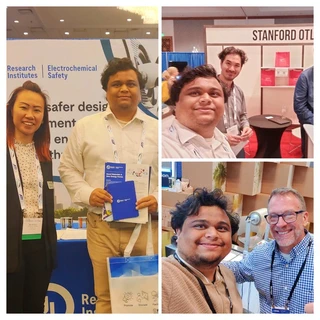
Welcome 👋
Table of Contents
Overview
Academic research often focuses on scientific discovery and technological advancement. However, translating a laboratory innovation into a real-world product requires a deep understanding of market needs, industry challenges, and potential customers. My participation in the National Science Foundation (NSF) I-Corps Program provided a unique opportunity to bridge this gap.
As the Entrepreneurial Lead (EL) of our team, I worked alongside my research supervisor and industry collaborators to explore the commercialization potential of our technology: Nano-Carbon Enhanced Optimizable Phase Change Materials (NEO-PCM). The program challenged us to step outside the laboratory and engage directly with industry professionals to understand how our technology could create real value.
What is NSF I-Corps?
The NSF Innovation Corps (I-Corps) program is designed to help researchers evaluate the commercial potential of their technologies. Unlike traditional academic training, the program emphasizes customer discovery, market validation, and entrepreneurial thinking.
One of the core principles of I-Corps is simple but powerful:
“Get out of the building.”
Instead of assuming who the customers are, teams must go out and talk to them.
Our Technology: NEO-PCM
Our project focuses on Nano-Carbon Enhanced Optimizable Phase Change Materials (NEO-PCM). These advanced materials are designed to improve thermal energy storage and temperature regulation in various applications, including:
- 👉 Cold-chain logistics and pharmaceutical storage
- 👉 HVAC and building energy efficiency
- 👉 Electronics cooling and thermal management
- 👉 Sustainable packaging and temperature-controlled shipping
By incorporating functional nano-carbon materials, the NEO-PCM technology aims to improve thermal conductivity, stability, and overall energy efficiency.
Customer Discovery: Talking to the Market
A major component of the I-Corps program is customer discovery interviews. As the team’s Entrepreneurial Lead, I conducted more than 100 interviews with professionals across multiple industries.
These conversations included:
- 💬 Industry engineers and technology managers
- 💬 Supply chain and cold-chain logistics experts
- 💬 Packaging and insulation companies
- 💬 Energy and HVAC specialists
- 💬 Investors and commercialization experts
The purpose of these interviews was not to sell our technology, but rather to listen and learn. Each discussion helped us understand:
- 💡 The real problems companies face
- 💡 Current technological limitations
- 💡 Market gaps and unmet needs
- 💡 Decision-making processes in industry
This process fundamentally reshaped our assumptions about the market.
Building a Business Model
Another critical component of the I-Corps journey was the development of a Business Model Canvas (BMC). The BMC framework helped us organize our understanding of the commercialization pathway by identifying key elements such as:
- Customer segments
- Value propositions
- Key partners
- Distribution channels
- Cost structure and revenue streams
By iteratively refining the business model based on feedback from interviews, we gradually aligned our technology with real industry needs rather than hypothetical assumptions.
Lessons from the I-Corps Experience
Participating in the NSF I-Corps program taught me several valuable lessons about technology commercialization:
1. Technology alone is not enough
Even a strong scientific innovation must solve a clearly defined problem for customers.
2. The market defines value
The perceived value of a technology depends on the needs and priorities of industry stakeholders.
3. Listening is more important than pitching
Customer discovery is about learning from conversations, not convincing people.
4. Iteration is essential
Assumptions must constantly be tested and refined as new information emerges.
Impact on My Research Perspective
The I-Corps experience significantly broadened my perspective as a researcher. It highlighted the importance of connecting fundamental research with real-world applications and market demand.
Rather than viewing commercialization as a separate activity, I now see it as a complementary process that can guide research directions and accelerate the adoption of new technologies.
My Takeaways
The NSF I-Corps journey was an invaluable experience that allowed me to explore the intersection of research, innovation, and entrepreneurship. By conducting over 100 industry interviews and developing a structured business model for NEO-PCM technology, our team gained a clearer understanding of how advanced materials can transition from laboratory research to impactful real-world solutions.
For researchers interested in bringing their innovations to market, the key takeaway from I-Corps is simple:
Go out, talk to people, and truly understand the problem you are trying to solve.
