
🔬🧪👩🔬📈 Collaboration with Brookhaven National Laboratory (BNL), NY, USA.

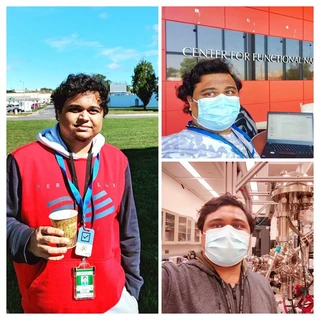
Scientific discovery often grows stronger through collaboration. During my Ph.D. research, I had the opportunity to work on several collaborative projects with scientists at the Center for Functional Nanomaterials (CFN) at Brookhaven National Laboratory (BNL) in New York, USA.
The CFN is a U.S. Department of Energy user facility that provides advanced characterization tools and scientific expertise for nanoscience research. Through this collaboration, I was able to investigate the structural and chemical properties of advanced nanomaterials using high-end facilities that are rarely available in standard laboratory environments.
These collaborative projects focused on understanding the structure–function relationships of nitrogen-doped graphene and metal–organic framework (MOF) based nanomaterials, particularly for electrochemical catalysis and thermal energy applications.
The Value of National Laboratory Collaboration
Working with a national laboratory such as BNL offers a unique research environment. The collaboration allowed our research team to combine:
Academic research at NJIT’s Advanced Energy Systems and Microdevices Laboratory
Advanced characterization facilities at CFN
Scientific discussions with experts specializing in nanomaterials and surface science
This environment enabled us to explore fundamental scientific questions about nanomaterials that would otherwise be difficult to investigate.
Beyond instrumentation, the collaboration fostered an atmosphere of scientific exchange, mentorship, and interdisciplinary problem solving.
Research Themes of the Collaboration
My collaborative work at CFN mainly focused on nitrogen-doped graphene (N-G) and metal–organic framework (MOF) based nanocatalysts. These materials are promising candidates for energy technologies because of their tunable structure and catalytic activity.
The key research topics I worked on include the following.
1. Durability of N-G/MOF Catalysts for Oxygen Reduction Reaction
One of the major projects focused on evaluating the durability of highly active MOF-modified nitrogen-doped graphene catalysts for the oxygen reduction reaction (ORR), a critical reaction in fuel cells and metal–air batteries.
This work aimed to understand how the catalyst structure evolves during long-term electrochemical operation and how structural degradation influences catalytic performance.
2. Evolution of Nitrogen Functional Groups in N-G/MOF Composites
Another key research question involved quantifying the changes in nitrogen functional groups when a metal–organic framework structure such as ZIF-8 is integrated with nitrogen-doped graphene.
Nitrogen functionalities—such as pyridinic, pyrrolic, and graphitic nitrogen—play a significant role in determining catalytic activity. Understanding how these groups evolve during material synthesis helps clarify the origin of catalytic performance.
3. Structural Evolution of Catalytic Active Sites
In addition to quantifying nitrogen groups, our work also investigated the chemical structural evolution of catalytic active sites formed during the integration of N-G and MOF materials.
By combining synthesis and advanced characterization, we examined how the interaction between graphene structures and MOF-derived components leads to the formation of new catalytic sites.
This insight is essential for designing more efficient non-precious metal catalysts for electrochemical energy systems.
4. Identification of Catalytic Sites in N-G/MOF Nanocatalysts
Another focus of the collaboration was to investigate the nature and distribution of catalytic active sites within N-G/MOF nanocatalysts.
Advanced characterization techniques helped us examine how different structural features—such as nitrogen configurations, carbon structure, and MOF-derived components—contribute to catalytic activity.
These studies contribute to the broader effort of replacing expensive platinum-based catalysts with sustainable carbon-based alternatives.
5. Nanomaterials for Enhancing Phase Change Materials (PCM)
Beyond electrocatalysis, our collaboration also explored the use of nitrogen-doped carbon nanomaterials and MOFs as additives for phase change materials (PCMs).
PCMs are widely used for thermal energy storage and temperature regulation. By integrating nanomaterials with PCMs, we investigated ways to enhance properties such as:
Thermal conductivity
Energy storage efficiency
Material stability
This work connects nanomaterial science with thermal energy management technologies.
Learning from the CFN Research Environment
Working with scientists at CFN provided valuable exposure to advanced research practices. The experience allowed me to:
– Conduct experiments using state-of-the-art characterization tools
– Collaborate with experts in nanomaterials and surface chemistry
– Interpret complex structural and spectroscopic data
– Connect fundamental material properties with device-level performance
These collaborations also strengthened the scientific foundation of several publications and ongoing research projects.
Personal Reflection
My experience collaborating with Brookhaven National Laboratory has been one of the most rewarding aspects of my doctoral research journey. The collaboration not only expanded the scope of our research but also provided valuable insights into how large-scale research facilities operate.
Working alongside scientists from different disciplines and institutions reinforced an important lesson in research: breakthrough discoveries often emerge from collaborative efforts that combine diverse expertise and resources.
My Thoughts on Collaboration with BNL
Collaborative research at national laboratories plays a crucial role in advancing modern science. My work with the Center for Functional Nanomaterials at Brookhaven National Laboratory allowed me to explore the complex chemistry and structure of advanced nanomaterials while contributing to the development of technologies for energy conversion and thermal energy storage.
These experiences continue to shape my approach to research, emphasizing both fundamental understanding and practical application of advanced materials.
